How Agentic Bookkeeping Solves the Accountant Shortage
By Dodocs Team | September 7, 2026 | 4 min read
By DoDocs Editorial Team
The year 2026 has brought the accounting profession to a historic crossroads. For years, the industry watched the "silver tsunami" of retirements approach while the pipeline of new talent steadily thinned. Today, that trend has culminated in a full-blown crisis. According to the 2026 Corporate Finance & Accounting Talent Research Study, the Talent Shortage Index has reached a staggering 77%, a sharp decline from the relative stability of the early 2020s.
For CFOs and partners at mid-sized accounting firms, the numbers are more than just statistics—they are operational bottlenecks. Firms are turning away new business not because there isn’t demand, but because there aren’t enough human hands to do the work. Starting salaries for entry-level staff have surged nearly 20% in the last few years, yet the number of new CPA candidates remains at record lows.
The traditional model of bookkeeping—one that relies on human staff to manually categorize every receipt, reconcile every bank statement, and chase every missing invoice—is no longer sustainable. It is too slow, too expensive, and, quite frankly, too prone to burnout.
However, a new paradigm is emerging: Agentic Bookkeeping. By leveraging AI agents that operate on a "Review-by-Exception" workflow, firms are finding they can scale their operations without adding a single new hire. Here is how DoDocs AI is solving the accountant shortage by turning one accountant into a team of five.
The Traditional Bottleneck: Manual Reconciliation and Human Drag
In a traditional firm, bookkeeping is a linear process. A transaction occurs, a human reviews it, tags it to a General Ledger (GL) code, and reconciles it against a bank statement. While automation tools have existed for a decade, they have largely been "rule-based." If a rule isn't perfectly met, the transaction falls into a "to-be-reviewed" bucket that requires manual intervention.
This creates a "human drag" on the firm’s growth. To take on ten more clients, you traditionally needed to hire one or two more bookkeepers. In 2026, those bookkeepers simply don’t exist in the local market, and offshore alternatives are facing rising costs and quality control challenges.
Furthermore, the manual nature of the work is the primary driver of the talent shortage. Young professionals entering the workforce in 2026 are not interested in data entry; they want to provide strategic value. When firms force high-potential talent into the "reconciliation grind," they lose them to more "exciting" roles in tech or consulting.
Enter Agentic Bookkeeping: The "Review-by-Exception" Revolution
Agentic Bookkeeping is not just "better automation." It is a fundamental shift in how work is distributed. In an agentic system, AI agents are not just following simple "if-then" rules; they understand context. They can read a messy receipt from a hardware store, look at the project history, cross-reference the budget, and decide whether it should be capitalized or expensed.
The breakthrough is the Review-by-Exception workflow.
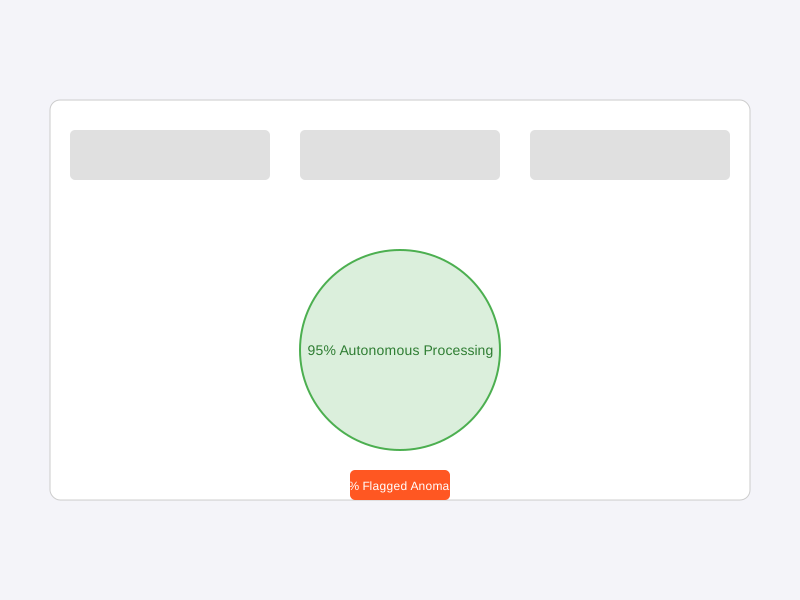
In this model, the DoDocs AI agents handle the bulk of the work autonomously. They process 95% of transactions with 99.9% accuracy. The human accountant—the "Controller" or "Reviewer"—only steps in when the AI encounters a genuine anomaly or a "grey area" that requires professional judgment.

How Review-by-Exception Works:
- Autonomous Intake: AI agents ingest data from bank feeds, email inboxes, and mobile uploads.
- Contextual Analysis: The agents apply GAAP principles and firm-specific logic to categorize and reconcile.
- Anomaly Detection: If a transaction is significantly outside the norm (e.g., a duplicate payment, a strange vendor, or a missing receipt for a high-value item), the agent flags it.
- Human Resolution: The human accountant receives a curated list of "Exceptions" to review each morning. Instead of spending 8 hours reconciling, they spend 30 minutes resolving high-priority flags.
This shift moves the accountant from a "data processor" to a "quality assurance officer." It leverages their expensive education for what it was meant for: judgment and strategy, not data entry.
Scaling Without Hiring: The 1:5 Ratio
The most immediate impact of DoDocs AI is the radical improvement in leverage. In the 2024 model, a single bookkeeper might have been able to manage 15 to 20 small business clients effectively. In the 2026 Agentic model, that same professional can manage 75 to 100 clients.
This "1:5 ratio" is the silver bullet for the accountant shortage.
When you can quadruple or quintuple the capacity of your existing team, the "shortage" disappears. You no longer need to find four more CPAs to grow your firm; you just need to equip your current team with the right agentic tools.
For CFOs, this means the cost of bookkeeping becomes a variable cost that scales with revenue, rather than a fixed cost tied to headcount. It allows for a higher margin on compliance work, which can then be reinvested into higher-value advisory services—the kind of work that clients actually want to pay for.
Beyond Efficiency: Reducing Burnout and Attracting Talent
The talent shortage isn't just a supply problem; it’s a retention problem. The "reconciliation grind" is the leading cause of burnout in mid-market accounting. By removing the repetitive, mind-numbing tasks, Agentic Bookkeeping makes the profession attractive again.
When you tell a new graduate that their job will involve managing a fleet of AI agents and focusing on complex financial strategy from Day 1, you become the employer of choice. Firms using DoDocs AI are seeing a 40% increase in retention rates because their staff feels like they are actually practicing their craft rather than performing data entry.

The Future of the Mid-Sized Firm
Consider the case of a 20-person firm in Atlanta. In 2025, they were struggling. Three of their senior staff retired, and they couldn't fill the roles despite offering $10,000 sign-on bonuses. They were at a point of "negative growth," where they had to fire clients because they couldn't service them.
By implementing DoDocs AI and moving to an agentic workflow, they were able to:
- Absorb the workload of the retired staff without hiring replacements.
- Reduce turnaround time on monthly closes from 15 days to 3 days.
- Launch a new advisory service focused on cash-flow forecasting, which now accounts for 25% of their revenue.
The shortage didn't break them; it forced them to evolve.
Conclusion: The New Standard for 2027 and Beyond
The accountant shortage of 2026 is a structural reality that isn't going away. The pipeline of new CPAs will take years, if not a decade, to recover. Firms that continue to wait for the "labor market to improve" will find themselves unable to compete with the speed and pricing of AI-native firms.
Agentic Bookkeeping is the bridge to the future. It allows firms to stop viewing labor as their primary constraint and start viewing it as their primary advantage. By using DoDocs AI to handle the "Review-by-Exception" workflow, you aren't just solving a staffing problem—you are building a scalable, resilient, and modern financial practice.
Stop searching for unicorns. Start scaling with DoDocs AI.
Ready to see how Agentic Bookkeeping can transform your firm? Schedule a demo with DoDocs today.
More articles
From Chasing Clients to Supervising Systems: Managing Modern Accounting Teams
By DoDocs Editorial Team | October 19, 2026 | 3 min read
Cutting the Fat: How Startups Save $15,000+ Annually on Bookkeeping with DoDocs AI
By DoDocs Editorial Team | October 19, 2026 | 3 min read
The Annual ROI of Automation: Reclaiming 120 Hours of Founder Time
By DoDocs Editorial Team | October 19, 2026 | 3 min read