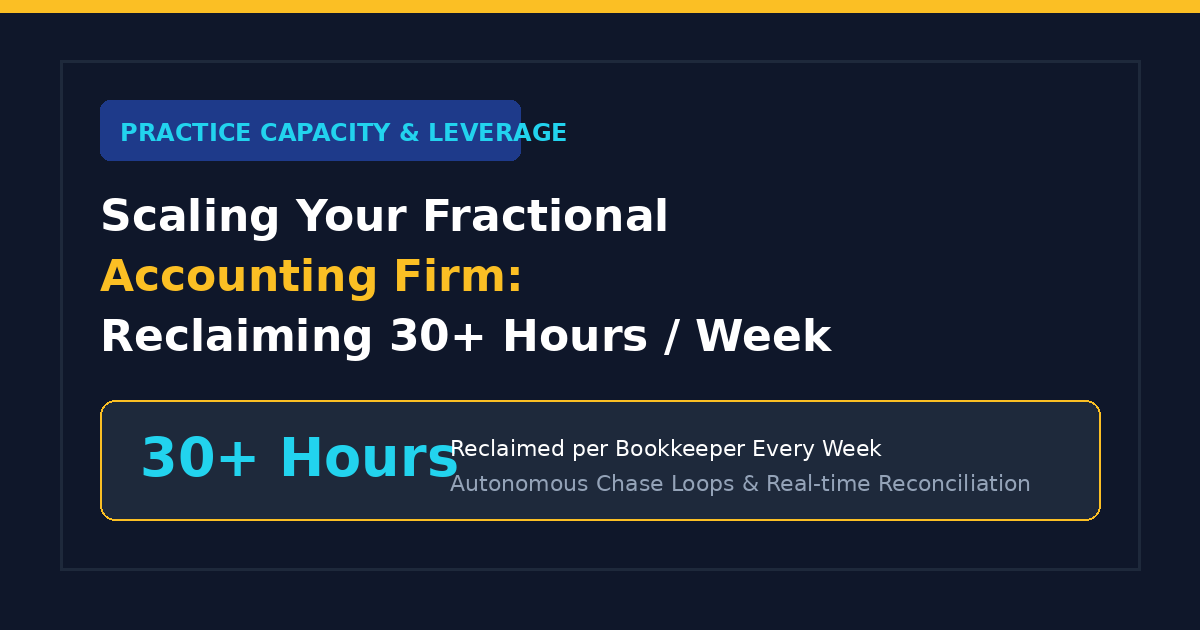
Scaling Your Fractional Accounting Firm: Reclaiming 30+ Hours per Week per Bookkeeper
By content-writer | October 23, 2026 | 6 min read
Key Takeaways
- Fractional accounting firms lose up to 40% of their billable capacity to manual document chasing and transactional reconciliation.
- Employee burnout and high turnover are the natural results of forcing skilled bookkeepers to act as manual data entry clerks.
- Automating the client-facing document pipeline with DoDocs AI allows firm owners to manage teams by exception, tripling output per staff member.
Scaling Your Fractional Accounting Firm: Reclaiming 30+ Hours per Week per Bookkeeper
Fractional accounting firms and outsourced CFO practices operate in a highly competitive, low-margin environment. The business model depends on leverage: the ability of a small team of skilled bookkeepers and senior accountants to manage several dozen corporate clients simultaneously. However, as any firm owner knows, this leverage is heavily restricted by the friction of manual client communication and back-office administrative "plumbing."
The average bookkeeper manages only 8 to 12 active clients before reaching absolute capacity. Crucially, they aren't hit by a shortage of analytical skill—they are hit by a bottleneck of manual document chasing, double-entry processing, and tedious reconciliation. In 2026, progressive fractional accounting firm owners are leveraging autonomous Intelligent Document Processing (IDP) to completely redesign their team operations, uncoupling practice growth from headcount and creating a highly scalable "Review-by-Exception" workflow model.
The multi-client operational bottleneck
Managing a fractional accounting team is a constant balancing act. Each client has their own unique processes, different bank feeds, and various vendor relationships. This operational fragmentation creates three severe bottlenecks for firm management:
- The Client Chasing Tax: Bookkeepers waste up to 10 hours per week sending polite, repetitive email and WhatsApp reminders to clients, requesting missing statements, receipts, and invoices.
- Manual Transaction Processing: Copying and typing invoice details into QuickBooks, Xero, or Zoho is a massive time-sink that is highly vulnerable to human input errors, which then require expensive senior review to correct.
- Month-End Stress and Staff Burnout: Because document collection is delayed, teams are forced to process a massive backlog of transactions in the final 72 hours of the month, resulting in high employee stress, burnout, and costly staff turnover.
For firm owners, this linear relationship between client volume and staff headcount is a major barrier to scalability. If taking on five new clients requires hiring another full-time bookkeeper, the firm’s net profit margins remain permanently compressed.
Rebuilding team leverage with DoDocs AI
DoDocs AI completely restructures how fractional accounting teams operate. By deploying specialized, autonomous cognitive agents, DoDocs automates the entire client-facing document pipeline from collection to ledger posting, allowing your existing team to work at three times their previous capacity.
1. Autonomous, white-labeled client chase loops
Instead of your bookkeepers spending their billable hours manually emailing clients for missing documentation, DoDocs AI handles the communication autonomously. The system automatically monitors bank feeds, detects missing invoices or receipt attachments for transactions, and reaches out directly to the client via WhatsApp or email with a white-labeled, 1-click upload link. Your team is completely removed from the routine communication loop.
2. Layout-agnostic cognitive extraction
Traditional OCR tools require custom templates for every vendor layout. If a client changes suppliers, the template breaks, causing a system exception. DoDocs AI uses advanced, context-aware LLMs to read and comprehend financial documents like an experienced human accountant. It extracts line items, tax numbers, and terms with 99.4% precision from any layout, completely eliminating manual data entry.
3. Continuous three-way matching and reconciliation
DoDocs AI performs bank reconciliation continuously throughout the month as transactions occur. When a bank charge hits, the system automatically locates the corresponding receipt in the document queue, verifies the numbers, assigns the correct General Ledger (GL) classification, and logs the matched entry. Your month-end close stops being a fire drill and becomes a quiet, non-event.
Managing your team by exception
From a firm ownership and team management perspective, the greatest impact of DoDocs AI is the transition to a "Review-by-Exception" operational framework.
Instead of your bookkeepers spending 80% of their day manually typing and 20% validating, the ratio is completely inverted. DoDocs AI processes and reconciles 95% of routine transactions autonomously in the background. Your staff is only alerted when the system detects a genuine anomaly—such as an unmatched price discrepancy or a new vendor without a clear GL classification.
This structural shift transforms team management:
- Triple Your Client Capacity: Existing staff members can comfortably manage 25 to 30 active fractional clients without working overtime, drastically increasing firm revenue without expanding payroll.
- Eradicate Employee Burnout: Removing repetitive, mind-numbing administrative work allows your bookkeepers to focus on high-value, rewarding strategic advisory services—which directly increases job satisfaction and reduces employee turnover.
- Maximize Profit Margins: By lowering the cost to service each client, firm owners can expand their net profit margins by up to 62%, creating a highly profitable, scalable business model.
To scale a modern fractional accounting practice, you must stop managing tasks and start supervising systems. DoDocs AI provides the autonomous infrastructure required to turn your firm into a high-capacity, high-margin advisory powerhouse.
More articles
Cutting the Fat: How Startups Save $15,000+ Annually on Bookkeeping with DoDocs AI
By content-writer | October 23, 2026 | 5 min read
From Chasing Clients to Supervising Systems: Managing Modern Accounting Teams
By content-writer | October 23, 2026 | 6 min read
The Annual ROI of Automation: Reclaiming 120 Hours of Founder Time
By content-writer | October 23, 2026 | 5 min read