Eliminating Month-End Reconciliation Bottlenecks
By DoDocs Editorial Team | November 9, 2026 | 5 min read
Key Takeaways
- Month-end close is delayed by batch processing: Treating reconciliation as a monthly event forces finance teams into reactive document chasing and manual matching under tight deadlines.
- Rule-based matching fails on real-world variability: Legacy OCR and rigid IF/THEN rules breakdown when transaction descriptors, line items, or receipt formats vary slightly.
- Continuous reconciliation shifts focus to exceptions: Autonomous agentic workflows match bank feeds to documents in real time, leaving accountants to handle only flagged discrepancies.
The Anatomy of the Month-End Bottleneck
For accounting practices and corporate finance teams across North America, the first five business days of every month follow a predictable pattern of stress. Staff accountants spend dozens of hours cross-referencing bank statements against incoming invoices, expense receipts, and ledger accounts. According to benchmark surveys by the American Institute of CPAs (AICPA), mid-sized accounting practices spend over 30% of their operational hours during close week simply locating documents and manually verifying line items.
The primary root cause of this delay is batch processing. When transactions sit unverified until the close window opens, missing receipts and ambiguous bank descriptors accumulate into a massive backlog.
Consider a mid-sized bookkeeping practice managing 30 active client accounts in the US. At the end of each month, senior bookkeepers must manually reach out to clients for missing receipt documentation across hundreds of credit card transactions. A single unmapped expense of $4,500 can stall the entire reconciliation process for a client's monthly balance sheet, forcing staff into last-minute email follow-ups while reporting deadlines loom.
Why Traditional Rule-Based Matching Breaks Down
To solve reconciliation delays, many finance departments rely on native automation tools built into traditional cloud accounting software. However, rule-based auto-matching algorithms operate on exact keyword string matching and fixed threshold rules. In real-world business operations, financial documentation is inherently unstructured and inconsistent.
Bank statement lines frequently shorten vendor names or append arbitrary transaction codes. Invoices arrive as unstructured PDFs, scanned image files, or inline email text. When an incoming data point deviates even slightly from predefined criteria, standard matching rules fail quietly, routing the record into an unclassified bucket for manual human review.
For example, a growing tech startup using standard cloud bookkeeping tools receives an invoice from a cloud infrastructure vendor labeled "Amazon Web Services Inc." for $1,250.00. However, the corresponding bank feed entry appears as "AMZN Mktp US*2K93X Seattle WA". A conventional IF/THEN rule looking for "Amazon Web Services" fails to match the statement line automatically. As a result, an accountant must open the PDF invoice, compare tax subtotals, manually override the transaction entry, and re-assign the general ledger (GL) code. Multiplied across hundreds of monthly transactions, rule-based automation yields diminishing returns.
Transitioning to Continuous, Agentic Reconciliation
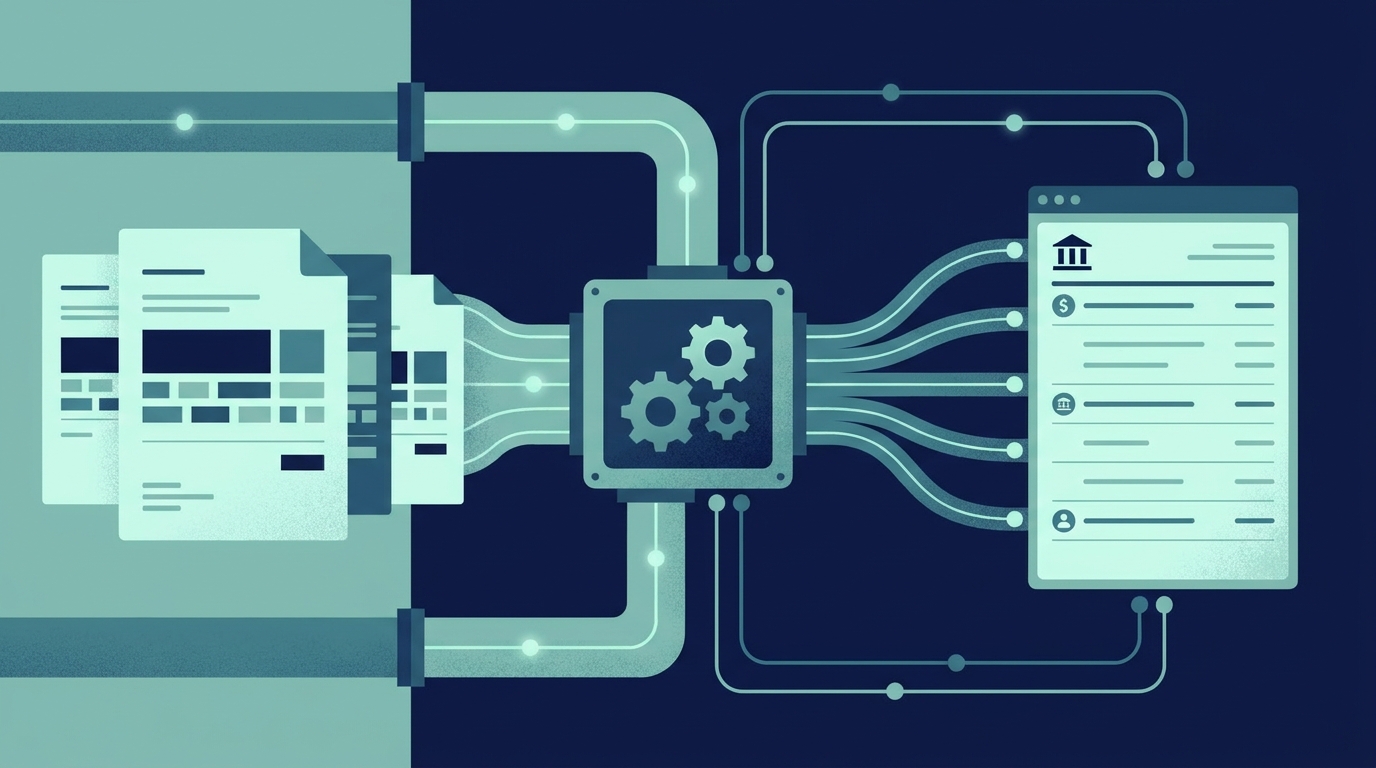
Eliminating close-period bottlenecks requires shifting from periodic batch reconciliation to continuous, agentic document verification. Rather than waiting for statement cut-off dates, modern Autonomous Accounting Operating Systems evaluate transactions continuously as documents arrive in real time.
Agentic financial workflows combine optical character recognition with semantic LLM understanding and probabilistic matching. When a document reaches the system via email, API, or cloud storage, AI agents extract header details, itemized line items, and tax breakdowns. The system then cross-references this structured data against live bank feeds, purchase orders, and historical posting patterns.
Consider a multi-entity retail enterprise operating five locations across California. Under a continuous reconciliation model, whenever a store manager submits an equipment repair receipt via mobile upload, an AI agent immediately extracts vendor name, line items, sales tax, and payment date. Within seconds, the agent matches the receipt against the pending credit card feed, verifies matching amounts, and drafts the GL journal entry. By the time month-end arrives, 95% of routine transactions have already been matched and verified continuously, eliminating the end-of-month panic.
Building an Exception-Based Finance Operations Workflow
When continuous document verification handles routine transaction matching, the role of staff accountants shifts from manual data entry to exception management. Instead of reviewing every transaction line by line, accounting professionals only inspect high-risk or ambiguous items flagged by the system.
In an exception-based workflow, AI matching agents assign confidence scores to every proposed ledger match. Transactions meeting high confidence thresholds are automatically reconciled according to established firm rules. Discrepancies—such as mismatched tax totals, unapproved vendors, or missing line items—are escalated into a centralized review queue with full context.
For example, an accounting firm handling fractional CFO services for mid-market clients processes 2,000 monthly transactions. Under an exception-based workflow, the AI agent automatically verifies and reconciles 1,880 routine items (94% auto-match rate). The remaining 120 items are flagged as exceptions—such as a price variance between a purchase order and an invoice—and presented to a senior accountant in a daily dashboard. The accountant resolves all 120 exceptions in under 45 minutes per day, maintaining audit-ready books without sacrificing accuracy.
Implementation Roadmap for Accounting Firms and CFOs
Transitioning to automated reconciliation does not require replacing existing core accounting infrastructure. Modern AI-native platforms integrate directly with established cloud platforms like QuickBooks Online, Xero, and NetSuite, augmenting existing ledgers with intelligent document routing.
To implement a continuous reconciliation workflow, finance leaders should take four structured steps:
- Audit Document Intake Channels: Map every source of incoming financial documentation (email inboxes, vendor portals, receipt capture apps) and centralize intake into an automated processing queue.
- Standardize General Ledger Mapping Rules: Define firm-wide parameters for vendor categorization, tax handling, and approval thresholds to give AI agents clear operational guidelines.
- Deploy Autonomous Matching Agents: Implement semantic AI document extraction to match incoming invoices and receipts against bank feeds on a rolling daily basis.
- Establish Human-in-the-Loop Oversight: Configure automated alert triggers for unmapped vendors, threshold variances, or missing backup documentation so accountants review only true exceptions.
For instance, a mid-sized accounting practice in Ontario deployed an autonomous document matching pipeline across 15 client accounts. Within 30 days of implementation, the firm reduced total monthly close time from 8 business days down to 2 days, allowing senior accountants to reallocate 40 hours per month toward strategic advisory services.
More articles

Solving Document Chasing in Modern Accounting Firms
By DoDocs Editorial Team | November 6, 2026 | 6 min read
Real-Time Cash Visibility & Daily Reconciliation
By content-writer | November 9, 2026 | 5 min read
From Chasing Clients to Supervising Systems: Managing Modern Accounting Teams
By content-writer | October 23, 2026 | 6 min read