Solving Document Chasing in Modern Accounting Firms
By DoDocs Editorial Team | November 6, 2026 | 6 min read
Key Takeaways
- Month-end document chasing wastes up to 20% of billable staff time in bookkeeping and CAS (Client Advisory Services) practices.
- Shifting from monthly batch requests to real-time transaction matching catches missing invoices within 24 hours of payment.
- The review-by-exception model handles 85%+ of routine documentation, freeing senior accountants to focus on advisory work.
- Standardizing continuous ingestion channels cuts month-end turnaround from 15 days to under 3 days across client portfolios.
Every accounting firm and SMB finance team recognizes the frantic cadence of the monthly close: accountants spending the first ten business days of every month sending follow-up emails, sending portal notifications, and calling clients to collect missing receipts, bank statements, and vendor invoices.
This post-facto document collection cycle—commonly known as "document chasing"—is one of the largest operational bottlenecks in modern Client Advisory Services (CAS) and bookkeeping practices across North America. According to industry benchmarks from the AICPA Firm Practice Management survey, staff accountants spend between 12 and 18 hours per client every month simply gathering and categorizing source documents.
The fundamental flaw is not client negligence; it is the traditional batch processing model. When accountants request receipts 30 days after a transaction occurred, context is lost, vendor invoices are buried in client inbox folders, and accountants are forced into fire-drill mode right before reporting deadlines.
To break this cycle, forward-thinking accounting practices and corporate finance teams are moving to continuous document ingestion powered by autonomous accounting systems.
The Hidden Cost of the Month-End Document Chase
In traditional accounting workflows, document collection is treated as an event that happens at month-end. However, when document gathering is deferred until reconciliation time, it creates compounding inefficiencies across the entire practice.
Consider a 15-person accounting practice managing 200 client entities across retail, technology, and professional services. Under a traditional monthly batch workflow:
- Information Decay: A client manager who made a $4,500 equipment purchase on May 3rd rarely remembers the line-item details or tax treatment when questioned on June 8th.
- Context Switching: Accountants spend hours jumping between accounting software, client communication portals, email threads, and cloud storage folders to stitch together single audit trails.
- Capacity Ceiling: Senior accountants become administrative handlers rather than strategic advisors, capping firm capacity at roughly 12 to 15 complex business clients per senior staff member.
For example, when an mid-sized logistics company in Ontario underwent a routine sales tax audit, their external bookkeeping team spent over 60 billable hours retroactively locating missing bill-of-lading receipts for transactions processed six months prior. The absence of immediate, structured ingestion turned a standard review into an expensive operational disruption.
Shifting from Batch Chasing to Continuous Ingestion
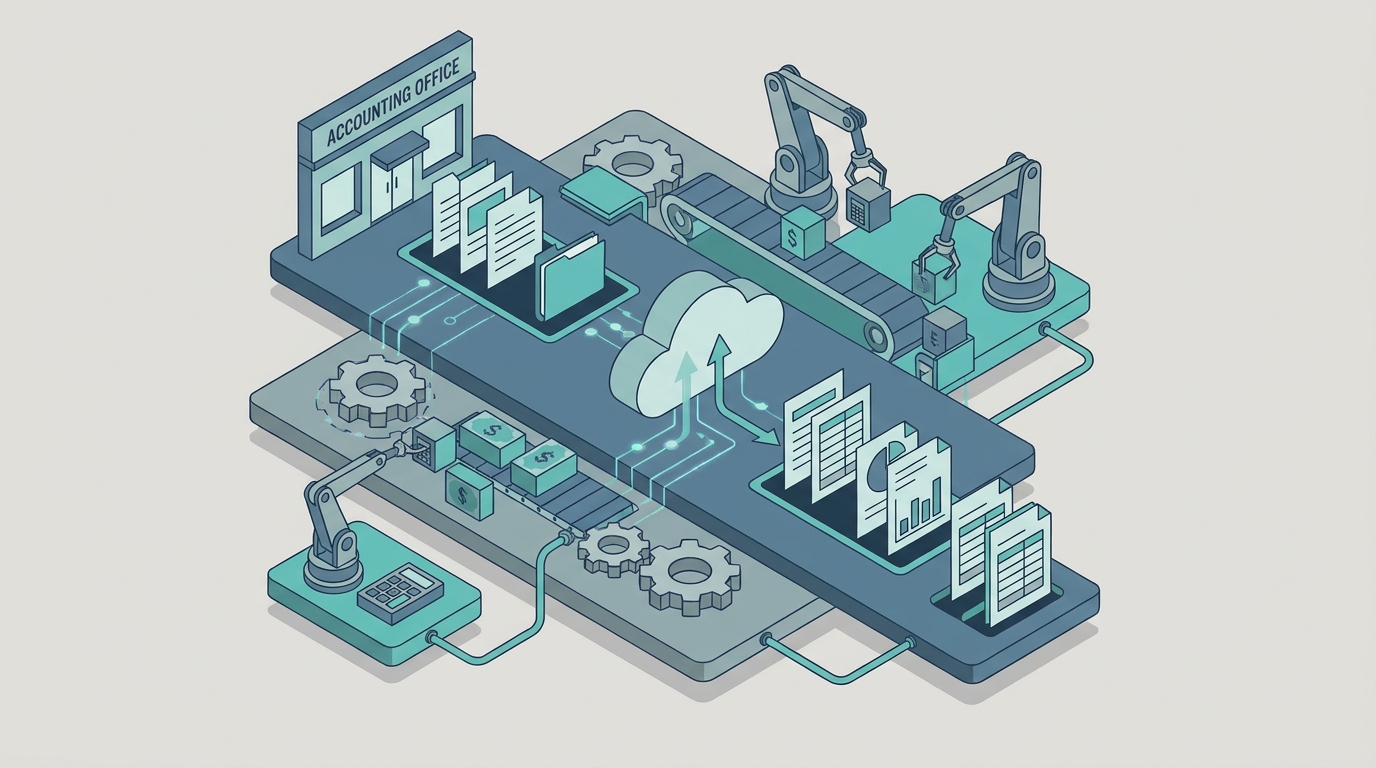
The alternative to month-end document chasing is continuous ingestion. Rather than asking clients for missing documents in bulk at the end of the billing cycle, continuous workflows connect document capture directly to payment events as they occur.
In an autonomous accounting environment, bank feeds and corporate card transaction feeds are continuously monitored. When a transaction posts to the general ledger, the system automatically correlates the date, amount, vendor, and metadata against incoming digital documents.
For instance, consider how a mid-sized US tech firm handles employee corporate card spending:
- Day 1 (Transaction): An executive purchases $1,200 of cloud infrastructure credits on an enterprise credit card.
- Day 1 (Instant Ingestion): The underlying document processing system ingests the vendor invoice from a monitored billing email inbox or API connection, parses the vendor name, line items, and sales tax rate, and matches it directly to the credit card pending feed.
- Day 2 (Reconciliation): The matched entry is provisionally coded into the general ledger under Software Expenses without any manual intervention or client email reminders.
If a transaction lacks a supporting invoice 24 hours after posting, an automated micro-prompt is triggered directly to the cardholder while the purchase is still fresh in mind. This eliminates the month-end backlog before it can accumulate.
Implementing Review-by-Exception in Client Accounting Services
Replacing document chasing requires a shift in how accountants interact with financial data. In traditional bookkeeping, human staff verify every single invoice and receipt manually. Under an autonomous review-by-exception model, software handles the repetitive matching, and accountants step in only when anomalies occur.
Modern document intelligence platforms use advanced multi-modal extraction to read unstructured invoices, receipts, and receipts in PDF or image format, standardizing them into structured general ledger entries.
Consider a practical example in a multi-location healthcare practice in Texas:
- Routine Automation (85-90% of Volume): Monthly recurring utility bills, medical supply purchases from primary vendors, and standard facility leases match existing rules and historical coding defaults. The system extracts line items, validates tax rates, attaches the source PDF to the ledger record, and queues the transaction for batch approval.
- Exception Flagging (10-15% of Volume): A new vendor invoice arrives with ambiguous payment terms (e.g., 50% upfront deposit with partial delivery) or a vendor name slightly differing from the master chart of accounts.
- Human Resolution: The senior bookkeeper receives a structured notification containing the extracted metadata, the highlighted source PDF, and two recommended accounting treatments. The bookkeeper clicks to confirm in under 30 seconds.
By routing only true exceptions to human accountants, the firm reduces manual processing time per document from 4 minutes down to under 15 seconds.
Standardizing Document Workflows Across Client Portfolios
A primary cause of document chasing in accounting firms is client fragmentation. One client uploads receipts to a Google Drive folder, another forwards emails, a third uses a custom portal, and a fourth hands over physical paper at month-end.
To eliminate chasing, accounting firms must establish standardized, multi-channel ingestion protocols that require zero behavioral change from clients:
- Dedicated Ingestion Inboxes: Every client entity receives a dedicated, secure email address (e.g.,
[email protected]) where vendors or AP teams forward invoices directly. - Mobile Snapshot Capture: On-the-go employees submit physical receipts instantly via mobile upload, where optical character recognition extracts merchant, date, and tax details in real time.
- Direct Vendor Connections: Integrating directly with major utility, software, and financial services APIs to retrieve digital statements automatically on statement closing dates.
When a 30-person bookkeeping agency in Chicago standardized client ingestion across 120 SMB clients, they eliminated client-side upload friction completely. Within two months, the proportion of monthly transactions with attached source documentation by day 5 of the close jumped from 42% to 91%.
The Bottom-Line Impact on Firm Capacity and Margins
Eliminating document chasing is not merely an operational convenience—it directly impacts firm profitability and talent retention.
Accounting practices operating on fixed monthly retainers experience immediate margin expansion when manual document retrieval is automated. When accountants spend less time managing missing document spreadsheets, firms achieve:
- 40%+ Increase in Client Capacity: Senior bookkeepers can manage 25 to 30 client entities effectively, up from 12 to 15 under manual batch workflows.
- Faster Close Cycles: Average month-end close turnaround drops from 15 business days to 2 to 3 days, providing SMB leadership with timely financial visibility.
- Higher Staff Retention: Junior and senior accountants focus on financial analysis, cash flow forecasting, and advisory work rather than administrative chasing, significantly reducing burnout during peak cycles.
By shifting from reactive document chasing to proactive, continuous ingestion, accounting firms and corporate finance teams transform document processing from an expensive bottleneck into an automated background engine.
More articles
Real-Time Cash Visibility & Daily Reconciliation
By content-writer | November 9, 2026 | 5 min read
Cutting the Fat: How Startups Save $15,000+ Annually on Bookkeeping with DoDocs AI
By content-writer | October 23, 2026 | 5 min read
Scaling Your Fractional Accounting Firm: Reclaiming 30+ Hours per Week per Bookkeeper
By content-writer | October 23, 2026 | 6 min read