Automating 1099 Vendor Compliance for Bookkeeping Firms
By DoDocs Editorial Team | November 23, 2026 | 7 min read
Key Takeaways
- 1099 compliance must be a continuous year-round workflow, not a January panic.
- Manual W-9 collection and ledger auditing cost accounting practices up to 15 hours per client entity annually.
- Automated TIN matching and document intake prevent IRS B-Notices, backup withholding penalties, and duplicate 1099 filings.
Every January, accounting firms and Client Advisory Services (CAS) practices face an intense administrative hurdle: 1099 filing season. Between chasing missing Form W-9s, auditing general ledger vendor accounts, verifying Taxpayer Identification Numbers (TINs), and separating credit card payments from ACH transfers, firm capacity is severely constrained during peak tax preparation months.
Under Internal Revenue Service (IRS) regulations, businesses must file Form 1099-NEC for each non-employee service provider paid $600 or more during the calendar year. Failure to file or submitting incorrect vendor information incurs statutory penalties under IRC Section 6721, ranging from $60 to over $310 per form depending on how late the correction occurs. For CAS practices managing dozens or hundreds of client entities, manual compliance introduces significant risk and overhead.
By implementing continuous, automated 1099 compliance workflows, modern accounting practices transform year-end stress into a streamlined, high-margin service offering.
The Year-End 1099 Bottleneck in Modern CAS Practices
For growing bookkeeping and CAS practices, the traditional approach to 1099 reporting is reactive. Accounting teams attempt to audit vendor ledgers after the tax year ends, attempting to collect tax identity information from contractors who may no longer be active vendors.
Consider the operational reality of "Pine & Oak Advisory," a mid-sized accounting firm managing 35 client entities across US states. Each January, senior bookkeepers expend over 120 aggregate hours running vendor expense reports, emailing contractors for missing Form W-9s, manually checking corporate entity structures, and re-keying data into e-filing portals. Because contractors often change addresses or fail to respond quickly, firm staff spend critical hours on low-value administrative follow-up.
Transitioning from reactive year-end auditing to continuous document ingestion solves this capacity bottleneck. When tax identity collection is integrated directly into accounts payable (AP) and document intake, compliance becomes an automated byproduct of daily bookkeeping.
Step 1: Upstream W-9 Intake at the Vendor Creation Stage
The most common failure point in 1099 compliance occurs when a business pays a new vendor before receiving a valid Form W-9. Once a payment is disbursed, contractor incentive to provide tax documentation drops significantly, forcing accounting firms into months of document chasing.
Automating upstream W-9 intake solves this by mandating tax documentation as a prerequisite for invoice approval and payment batching. Modern AP workflows automatically parse incoming vendor onboarding forms and invoices. If a new vendor is flagged as an individual, LLC, or partnership without a W-9 on file, the system triggers an automated, secure request link directly to the contractor.
For example, when "Apex Logistics"—a client of Pine & Oak Advisory—onboarded a freelance software consultant, the firm's document processing workflow identified the invoice from a new unincorporated entity. Before the manager could queue the payment for execution, the automated platform emailed the contractor a digital Form W-9 submission portal. The completed, signed Form W-9 was ingested, extracted, and attached to the vendor record in the accounting system in under 10 minutes, eliminating future year-end chasing.
Step 2: Automated IRS TIN Matching and Entity Verification
Obtaining a Form W-9 is only half the battle; the information on the form must match IRS records exactly. Discrepancies between a vendor's legal name and their Taxpayer Identification Number (TIN/EIN/SSN) trigger IRS CP2100 or CP2100A Notices (B-Notices). When a B-Notice is issued, payers are legally required to initiate 24% backup withholding on future vendor payments or face direct liability for uncollected taxes.
Automated TIN matching cross-references vendor legal names and identification numbers directly against the IRS e-services database at the moment of document intake. Intelligent document processing tools parse W-9 forms, extract federal tax classification details, and flag discrepancies before payments or 1099s are processed.
For example, a vendor submitted an invoice under the trade name "Redwood Creative," but their Form W-9 listed the legal entity name as "Redwood Design LLC" with a single-member owner SSN. A manual bookkeeper might register the vendor under the trade name, leading to an immediate IRS TIN mismatch. Automated verification detects the difference between the d/b/a name and the federal tax identity, auto-populating the correct legal entity structure in the ledger and preventing future B-Notice penalties.
Step 3: Real-Time Payment Threshold Tracking Across Payment Channels
Calculating 1099-NEC reportable totals requires distinguishing between different payment methods. Payments made via credit cards, debit cards, or third-party payment settlement entities (such as PayPal or Stripe) are reported by the payment processor on Form 1099-K. Payers must not include these electronic transactions on Form 1099-NEC to prevent double-reporting vendor income.
Manual general ledger reviews struggle with this distinction, as staff must inspect individual transaction details across multiple bank feeds and merchant accounts. Automated transaction classification continuously analyzes transaction metadata from linked bank feeds and AP systems.
For example, "Midwest Marketing" paid a digital strategy consultant $4,500 via bank ACH transfer and $2,000 via corporate credit card throughout the year. A traditional manual review of GL account 6200 (Consulting Expense) would show $6,500 in total disbursements, potentially leading to an over-reported 1099-NEC. Automated rules engine tags each disbursement by rail at the transaction level, correctly accumulating $4,500 for 1099-NEC reporting while tagging the $2,000 credit card portion as 1099-K exempt.
Step 4: Streamlined Year-End E-Filing and Recipient Delivery
The final stage of modern 1099 management is single-click filing and digital distribution. Under recent IRS regulations, the threshold for mandatory electronic filing has been reduced from 250 returns to just 10 returns across all information form types combined. Virtually all accounting firms and SMBs are now legally mandated to e-file.
When W-9 collection, TIN matching, and threshold calculations take place continuously throughout eleven months of the year, January filing is reduced to a quick validation check. Modern accounting automation platforms aggregate verified data, generate pre-formatted 1099-NEC and 1099-MISC files, and connect directly to IRS filing gateways like IRIS or FIRE.
For example, on January 12th, Pine & Oak Advisory's compliance dashboard presents pre-audited 1099 summaries for all 35 client entities. 99% of vendors display green verification status badges for W-9 and TIN alignment. The lead accountant reviews the summary dashboard, confirms exceptions in less than 30 minutes, and triggers automated e-filing along with secure e-delivery to contractor portals in a single batch action.
Transforming 1099 Compliance into a High-Margin CAS Advisory Workflow
Automating 1099 compliance turns a seasonal administrative burden into a predictable, year-round value driver. CAS practices that replace manual spreadsheet tracking with automated document ingestion and real-time ledger intelligence achieve significant operational benefits:
- Capacity Expansion: Senior accounting staff reclaim hundreds of hours during January, redirecting effort toward strategic CFO advisory and client onboarding.
- Risk Mitigation: Real-time IRS TIN matching prevents costly B-Notice penalties, backup withholding compliance failures, and client dissatisfaction.
- Fixed-Fee Profitability: Firms can package proactive compliance into standard CAS client retainers, capturing higher margins while delivering superior peace of mind.
By embedding automated tax document capture and intelligent verification into daily financial operations, accounting firms build a resilient foundation for scalable, modern client service.
More articles

Automating Multi-Entity Intercompany Reconciliation
By DoDocs Editorial Team | November 20, 2026 | 6 min read

Automating 3-Way Match in Accounts Payable
By DoDocs Editorial Team | November 18, 2026 | 6 min read
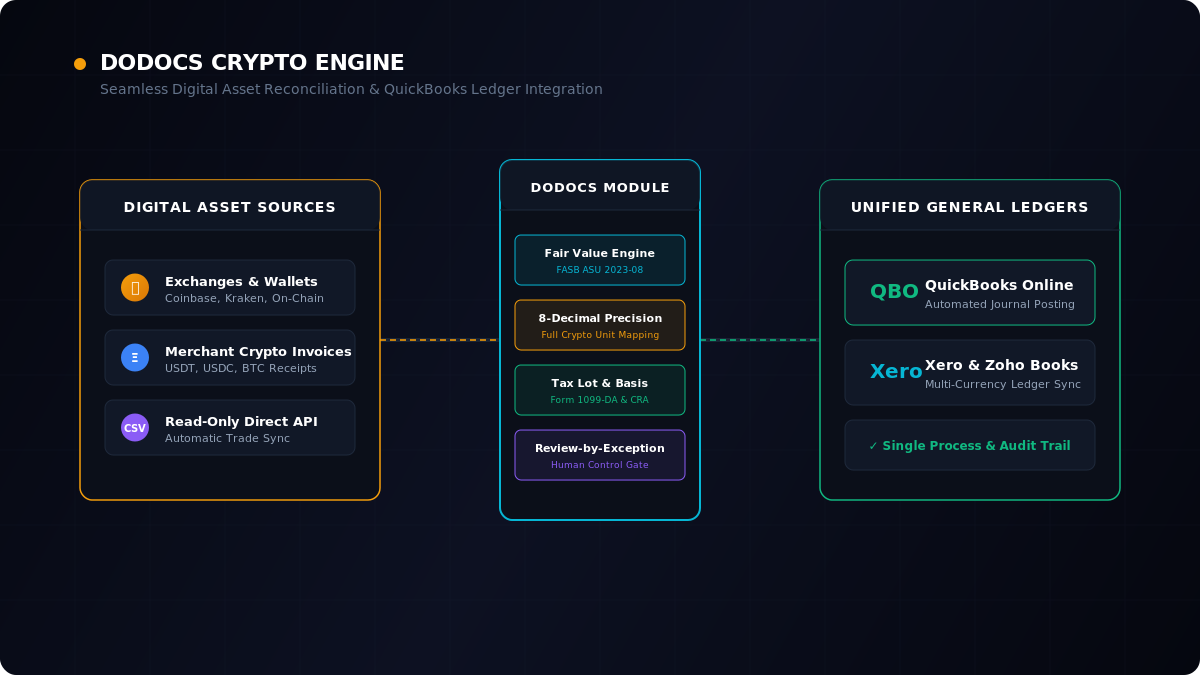
Crypto accounting that works inside QuickBooks: we are building it with accountants
By Dan Gudkov | November 16, 2026 | 5 min read