Crypto accounting that works inside QuickBooks: we are building it with accountants
By Dan Gudkov | November 16, 2026 | 5 min read
Key Takeaways
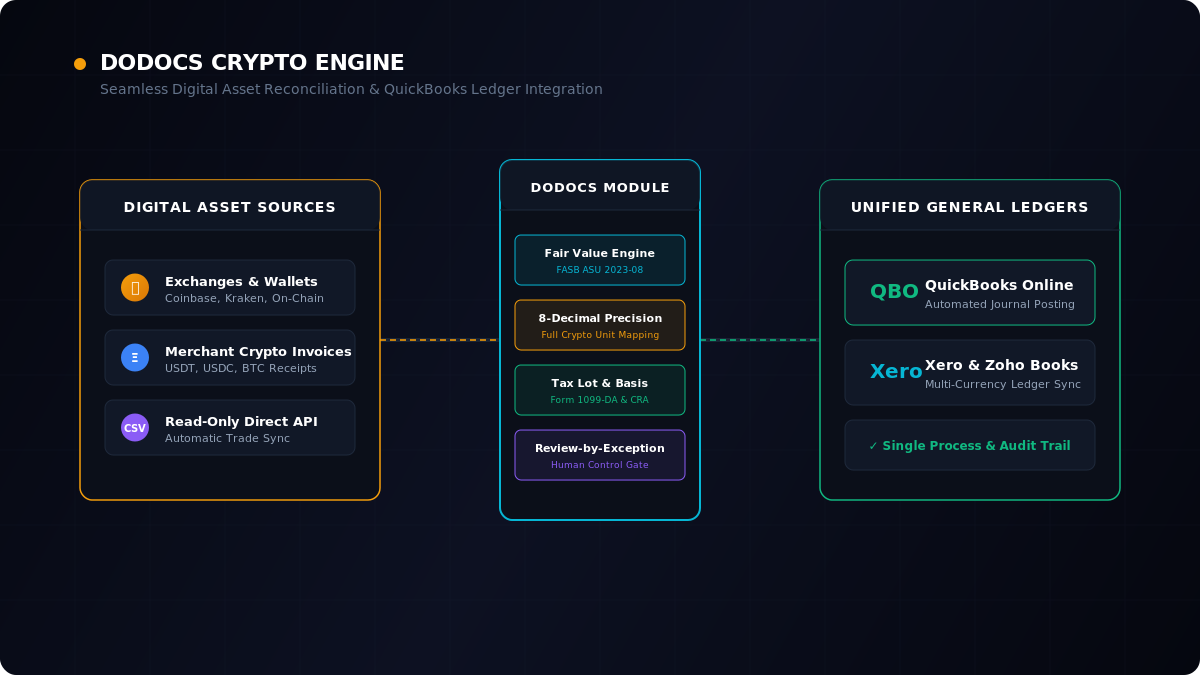
- Unifying crypto with general ledgers. Rather than maintaining separate spreadsheets, DoDocs AI integrates crypto exchange transactions directly into QuickBooks and Xero workflows.
- Solving the decimal & valuation problem. Automatically handles 8-decimal Bitcoin precision, FASB ASU 2023-08 fair-value adjustments, and Form 1099-DA / CRA compliance.
- Read-only security & control. Exchange connections are strictly read-only with human review gates before posting to the general ledger.
Over the past months, accounting firms have kept sending us the same request: can DoDocs handle crypto, and can it work with QuickBooks the way their other clients do?
Today we are saying yes to the direction and being honest about the stage. We are building a crypto accounting module, and nothing is built yet. Before we write the spec, we want to hear from the people who will use it every day: bookkeepers and accountants at fractional firms and in-house finance teams.
This post explains why we think crypto is hard to do well in traditional accounting software, what we are considering building, and exactly what we are asking you to tell us.
Why Crypto Breaks the Usual Workflow
Crypto is no longer a niche. A January 2026 PayPal and National Cryptocurrency Association survey found 39% of US merchants accept it at checkout. That means ordinary clients now show up with exchange accounts, wallets and invoices paid in coin, and their accountants inherit the books.
Three things make this painful:
- The software was not built for it. QuickBooks Online allows only two decimal places in an amount, while Bitcoin needs eight. There is no native link to exchanges or wallets, so most firms end up in spreadsheets and hand-built journal entries.
- The US rules changed. FASB’s ASU 2023-08 requires qualifying crypto assets to be measured at fair value through net income, for fiscal years beginning after December 15, 2024. For tax, basis has had to be tracked wallet by wallet since 2025, and the new Form 1099-DA reports proceeds without usable basis for most 2025 sales.
- Canada has its own demands. CRA decides case by case whether activity is business income or a capital gain. Businesses that accept crypto for taxable sales must value it at fair market value at the time and keep the records that show how they calculated it.
The accountant ends up as the integration layer between the exchange, the spreadsheet and the ledger. That is the work we want to take off your plate.
What We Are Considering Building
DoDocs already handles document chasing, extraction, reconciliation and posting for accounting firms. Crypto is the next area. These are working ideas, not commitments:
- Exchange Sync. Read-only connections to your clients’ exchanges that import trades, deposits, withdrawals and fees, with no CSV exports.
- Categorization You Approve. Each transaction valued in CAD or USD at the time it happened, with suggested income or expense categories that your team confirms.
- One Set of Books. Crypto posted to the same ledger, through the same review and close process you use for everything else. We are looking at QuickBooks, Xero, Odoo and Zoho.
- Controls Firms Can Trust. You choose which clients to connect and can disconnect at any time. Every suggested entry is reviewed before it posts, and changes are logged with the approver’s name. Connections are read-only, so the module cannot trade or move funds, and client data is not used to train AI models.
We are starting with Canada and the United States, because that is where the firms asking us are.
Tell Us What It Must Do
We would rather be corrected now than after we have built the wrong thing. Specific beats polite. These are the questions we most want your view on:
- Which exchanges, wallets and DeFi activity do your clients actually use?
- How many of your clients have crypto activity, and what breaks first when you handle it today?
- Do you need fair-value reporting, tax lots, or both?
- For Canadian clients: CAD valuation, GST/HST on crypto payments, capital versus income tagging?
- What controls and audit trail would you require before you let it post to a client’s books?
- What would make you not trust it?
The survey takes about three minutes: dodocs.ai/crypto. Contributors get first access to a limited beta and, if you want it, direct contact with our product team.
If you work in an in-house accounting department rather than a firm, tell us that too. The workflow differs, and we want to know where.
More articles

Automating Catch-Up Bookkeeping for CAS Practices
By DoDocs Editorial Team | November 16, 2026 | 7 min read
Streamlining Client Document Intake for Accounting Firms
By DoDocs Editorial Team | November 13, 2026 | 6 min read

Continuous Audit Readiness for Modern Accounting Teams
By DoDocs Editorial Team | November 11, 2026 | 6 min read