Streamlining Client Document Intake for Accounting Firms
By DoDocs Editorial Team | November 13, 2026 | 6 min read
Key Takeaways
- Fragmented client channels erode firm profitability by forcing staff accountants to waste up to 15 hours per week chasing missing receipts and invoices.
- Standardizing intake SLAs and centralizing entry points establishes clear expectations and reduces month-end document submission lag.
- Autonomous document matching pairs incoming financial artifacts directly with bank feeds, transforming manual data entry into exception-based review.
- Measuring Days to Receive (DTR) provides a quantifiable benchmark to evaluate document intake efficiency across client portfolios.
The High Cost of Unstructured Client Document Intake
Client Advisory Services (CAS) and outsourced bookkeeping practices thrive on recurring monthly engagements. However, the operational reality inside many firms is plagued by unstructured document intake. When clients send receipts via email attachments, mobile photos over messaging apps, shared drive uploads, or physical mail, firm productivity drops rapidly.
Consider a mid-sized CAS practice managing 40 business client accounts. Each month, staff accountants must collect, categorize, and reconcile hundreds of receipts, vendor bills, and bank statements. When document intake lacks structure, staff spend an estimated 10 to 15 hours per week sending manual reminder emails, cross-referencing bank feeds against incomplete files, and manually keying invoice details into general ledgers.
This operational drag directly impacts firm margins. Instead of spending time on high-value advisory services, skilled accountants act as document retrievers. The friction also delays month-end closes, pushing financial statement delivery well into the middle of the following month and frustrating clients who rely on timely financial reporting.
Building a Standardized Intake SOP Across Client Portfolios
To eliminate intake bottlenecks, forward-thinking accounting firms implement Standard Operating Procedures (SOPs) that unify how documents enter the practice. A robust intake SOP establishes strict guidelines for document formats, delivery channels, and submission deadlines.
For example, a regional bookkeeping firm working with 25 retail and e-commerce clients standardized intake by establishing a "Single Channel Entry" rule. Instead of accepting documents across scattered email threads and messaging channels, the firm onboarded all clients onto a unified document portal with strict submission SLAs. Clients were required to upload all month-end vendor bills and expense receipts by the 3rd business day of each month.
To ensure compliance, the firm automated submission reminders via scheduled notifications rather than relying on manual staff follow-ups. By standardizing the intake schedule, the firm reduced missing document rates at month-end from 35% down to under 8%, enabling staff to initiate reconciliation cycles days ahead of their previous baseline.
Transitioning from Manual Chasing to Autonomous Capture
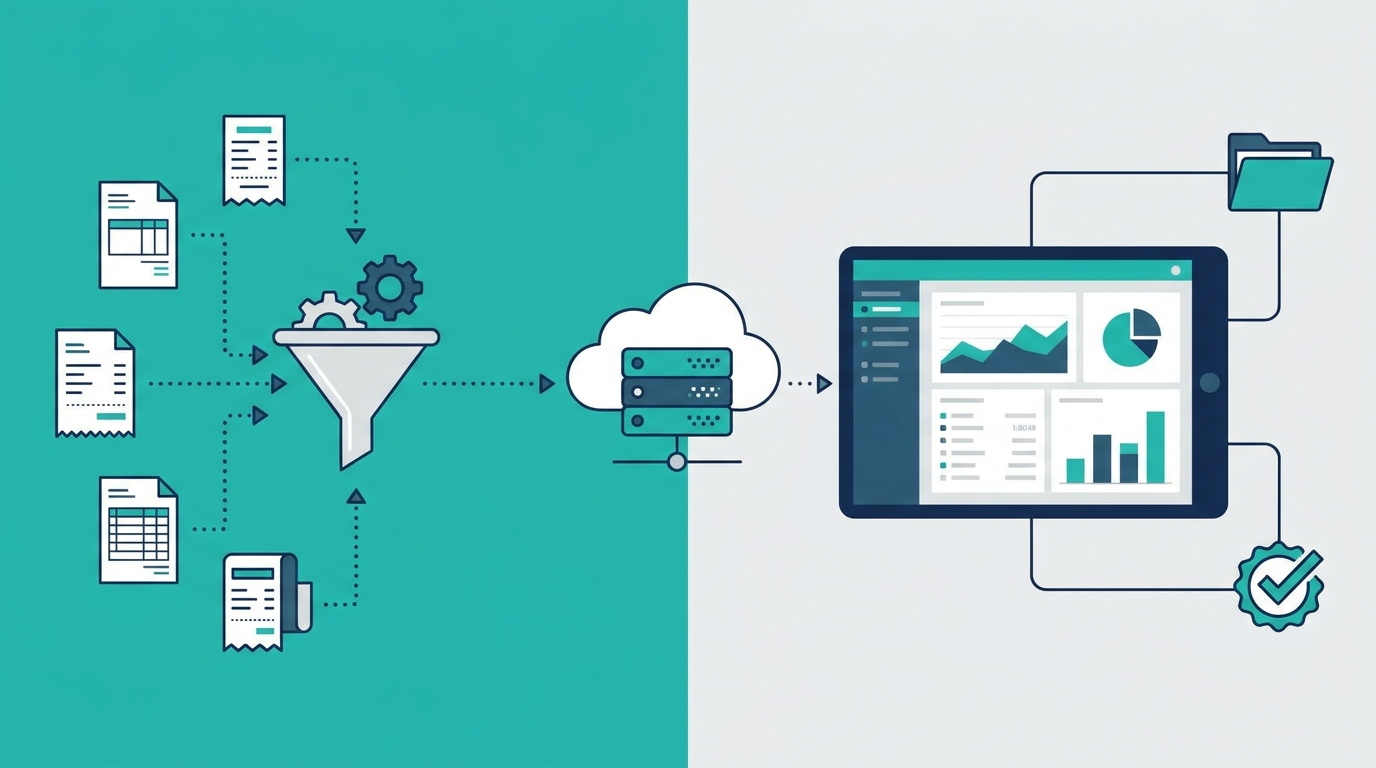
While standardized SOPs improve client compliance, relying solely on human habit changes has natural limits. Modern accounting firms supplement intake SOPs with autonomous document capture and intelligent matching technologies.
When a client submits an invoice or receipt, autonomous ingestion engines read header and line-item details—including vendor name, tax ID, transaction date, subtotal, sales tax, and line items—and immediately cross-reference the data against pending bank feed transactions.
For instance, consider a corporate finance team overseeing multiple subsidiaries. In a traditional workflow, an accountant reviews a $4,500 software subscription invoice, manually logs into the ERP, creates a vendor bill, and matches it against the credit card feed. With autonomous capture, the system ingests the digital invoice from the intake queue, extracts the vendor metadata, matches it to the corresponding credit card transaction in real time, and pre-populates the general ledger entry. The accountant’s role shifts from manual data entry to simply reviewing exceptions flagged by the system.
Key Metrics for Measuring Intake Efficiency
To evaluate whether document intake optimizations are delivering real operational ROI, firm leaders must track core performance indicators across their client portfolio.
- Days to Receive (DTR): The average number of days between transaction occurrence (or month-end) and receipt of the supporting document from the client. Reducing DTR from 12 days to under 3 days significantly accelerates closing cycles.
- Unmatched Transaction Ratio: The percentage of bank feed transactions lacking supporting documentation at month-end close. A healthy target for automated firms is under 5%.
- Capacity per Bookkeeper: The total number of client accounts a single staff accountant can manage effectively without sacrificing accuracy or working overtime. Autonomous document workflows frequently enable firms to increase client capacity per staff member by 40% to 60%.
For example, a growing accounting practice tracking DTR discovered that three specific clients accounted for over 60% of all month-end follow-up calls. By reviewing DTR metrics, firm managers identified specific client intake roadblocks, re-trained client staff on mobile document capture, and reduced total firm closing lag by five business days.
Modernizing Your Firm's Document Workflow
Transitioning your firm to a streamlined intake model does not require an overnight overhaul of every client relationship. Successful firms deploy a phased rollout strategy:
- Audit current intake channels: Inventory how documents currently enter your practice and identify the highest-friction channels.
- Select a dedicated ingestion tool: Implement specialized accounting document management platforms that integrate directly with your general ledger (e.g., QuickBooks Online, Xero, or enterprise ERPs).
- Update client engagement agreements: Include clear document submission guidelines and SLAs in client onboarding materials.
- Shift to exception-based review: Train staff to supervise automated matching systems rather than processing every invoice by hand.
By establishing structured intake SOPs and leveraging autonomous document processing like DoDocs AI, accounting firms and CFOs eliminate the monthly document chase, protect staff capacity, and deliver faster, more reliable financial insights.
More articles
Continuous Audit Readiness for Modern Accounting Teams
By DoDocs Editorial Team | November 11, 2026 | 6 min read
Eliminating Month-End Reconciliation Bottlenecks
By DoDocs Editorial Team | November 9, 2026 | 5 min read
Solving Document Chasing for Accounting Firms
By DoDocs Team | November 1, 2026 | 4 min read