Automating Multi-Entity Intercompany Reconciliation
By DoDocs Editorial Team | November 20, 2026 | 6 min read

Key Takeaways
- Multi-entity complexity scales exponentially with manual workflows. Operating multiple subsidiaries or management entities without automated document and transaction matching creates severe month-end reconciliation lag.
- Timing mismatches drive intercompany imbalance. When one entity logs an expense transfer without attaching source documents to the receiving ledger, intercompany receivables and payables drift out of sync.
- Audit readiness requires document-level linkage. Automated accounting operating systems ingest invoices once, extract entity-specific allocation metadata, and generate dual-entry transactions tied to a shared source file.
- Elimination entries become continuous, not quarterly. Pre-reconciling intercompany balances throughout the period removes the traditional month-end bottleneck during consolidation.
The Multi-Entity Complexity Trap
As mid-market companies scale and accounting practices expand their Client Advisory Services (CAS) offerings, multi-entity structures become the standard operational model. Whether managing multiple regional operating companies, real estate holdings, or dedicated management entities, multi-ledger architecture is essential for tax optimization and asset protection. However, managing intercompany transactions across separate general ledgers frequently becomes a major bottleneck during period-end close.
Consider a mid-size logistics provider operating across three distinct corporate entities: a parent holding company (Apex Holdings LLC), a Midwest operations entity (Apex Freight Midwest LLC), and a tech services entity (Apex Logistics Tech LLC). Each entity maintains its own chart of accounts and bank feeds. When Apex Holdings pays a consolidated $24,000 annual software license invoice covering enterprise ERP user seats across all three entities, the transaction spans multiple ledgers. In a traditional workflow, a staff accountant records the full $24,000 disbursement in Apex Holdings' ledger and manually drafts two intercompany journal entries to allocate $8,000 each to Midwest and Tech.
Without continuous cross-ledger automation, these manual allocation transfers rely on email threads, spreadsheet schedules, or physical document attachments. If the receiving accountants at Apex Freight Midwest or Apex Logistics Tech do not receive the backing invoice or delay entering the matching Intercompany Payable, the respective general ledgers fall out of balance. What begins as a routine software allocation quickly escalates into hours of ledger hunting during month-end close.
Root Causes of Intercompany Discrepancies
Intercompany account imbalances rarely stem from mathematical errors. Instead, they arise from systemic timing delays, asymmetric document access, and manual entry discrepancies across separate accounting files. For growing accounting practices supporting multi-entity clients, these structural friction points recur every period.
To illustrate the mechanics of discrepancy accumulation, take the example of shared management fees and cross-entity billings between a real estate development firm (Summit Development Group) and its property management subsidiary (Summit Property Management LLC). Every month, Summit Property Management incurs $45,000 in payroll and field expenses for technicians servicing properties owned directly by Summit Development Group.
Under standard accrual accounting, three distinct friction points disrupt reconciliation:
- Asymmetric Ingestion: Summit Property Management records the payroll disbursement on the 15th of the month, posting an Intercompany Receivable from Summit Development Group. However, the supporting line-item expense detail and vendor receipts are stored in the property management document portal, inaccessible to the parent company accounting team.
- Timing Asymmetry: Summit Development Group's accounting team delays recording the corresponding Intercompany Payable until the end of the month, pending physical invoice review. During the intervening 15 days, consolidated reporting shows phantom intercompany variance.
- Chart of Accounts Mismatches: Summit Property Management codes the reimbursement under account
1250 - Due from Parent, while Summit Development Group logs it under account2100 - Intercompany Payable - SPM. Without automated account mapping, automated reconciliation rules fail to pair the balances.
When multiplied across dozens of intercompany transactions per month—ranging from shared health insurance premiums to inventory transfers—these small discrepancies force finance teams into laborious manual tick-and-tie reconciliations at period-end.
AI-Driven Intercompany Document & Transaction Matching
Modern AI-first document intelligence and accounting operating systems resolve intercompany friction by decoupling document ingestion from manual ledger entry. Rather than relying on staff accountants to manually copy line items and pass PDF attachments between entities, an automated platform ingests multi-entity documentation into a centralized processing pipeline.
Consider how an automated Accounting OS handles the previous multi-entity software subscription scenario for Apex Holdings:
When the $24,000 vendor invoice enters the centralized document intake system, AI document extraction models identify key metadata fields: line-item costs, service dates, tax identification numbers, and entity allocation tags embedded in the line details. Recognizing that the invoice spans Apex Holdings, Apex Freight Midwest, and Apex Logistics Tech, the system automatically applies predefined entity allocation logic:
- Entity 1 (Apex Holdings): $8,000 -> Account 6100 (Software & Subscriptions)
- Entity 2 (Apex Freight Midwest): $8,000 -> Account 1300 (Due from Apex Freight Midwest)
- Entity 3 (Apex Logistics Tech): $8,000 -> Account 1310 (Due from Apex Logistics Tech)
Simultaneously, the platform drafts symmetrical incoming transactions for the receiving ledgers:
- Apex Freight Midwest General Ledger: Debit: Account 6100 (Software Expense) $8,000 | Credit: Account 2200 (Due to Apex Holdings) $8,000
- Apex Logistics Tech General Ledger: Debit: Account 6100 (Software Expense) $8,000 | Credit: Account 2200 (Due to Apex Holdings) $8,000
Crucially, both generated ledger entries automatically embed a direct hyperlink back to the original $24,000 vendor invoice stored in the central repository. Receiving accounting leads can inspect the underlying source document with a single click, eliminating document chasing and verification delays before posting.
Standardizing Elimination Entries for Faster Close
In multi-entity accounting, preparing consolidated financial statements requires eliminating intercompany balances to prevent double-counting revenues, expenses, receivables, and payables. Traditional consolidation software automates the mathematical removal of matching intercompany balances, but it stalls whenever intercompany ledgers do not match exactly.
For instance, consider a healthcare practice management firm (CarePoint Health) operating five regional clinical practices across North America. At the end of Q3, CarePoint's consolidated general ledger shows $312,000 in Intercompany Receivables on the parent ledger, but only $298,000 in Intercompany Payables across the five clinic ledgers—a $14,000 net imbalance.
Without automated pre-reconciliation, the consolidation software flags an unassigned intercompany variance, halting the reporting workflow. The accounting team is forced to conduct a manual line-by-line audit across six separate general ledgers to trace the $14,000 difference, which turns out to be a miscategorized equipment transfer from two weeks prior.
By introducing continuous intercompany matching, accounting practices transform consolidation from a high-stress month-end crunch into a daily background process:
- Real-Time Variance Detection: The system continuously compares Intercompany Receivable and Payable accounts across all connected ledgers, raising an immediate alert the moment an unmatched transfer is posted.
- Automated Document Linking: Every intercompany transaction carries a unified document tracking ID across all involved ledgers, allowing auditors and financial controllers to trace eliminations back to the originating bill or journal voucher.
- One-Click Pre-Approval: Intercompany balance changes require pre-posting approval from the receiving entity financial manager, ensuring that both ledgers remain synchronized before final period-end lock.
When intercompany accounts are pre-reconciled continuously, period-end elimination entries execute smoothly, reducing consolidation timelines from days to minutes.
Implementation Playbook for CAS Firms and CFOs
Transitioning to automated multi-entity intercompany workflows requires a structured implementation plan. CAS practice leaders and SMB CFOs can deploy this playbook to streamline multi-ledger management across their organizations:
- Standardize the Multi-Entity Chart of Accounts: Establish consistent intercompany naming conventions and account numbering across all subsidiaries. For example, ensure that every entity uses dedicated
Due ToandDue Fromsub-accounts paired explicitly to specific sister entities. - Centralize Ingestion & Intake: Funnel all multi-entity vendor bills, credit card statements, and expense receipts through a single AI document processing pipeline capable of multi-entity tag routing.
- Configure Automated Allocation Templates: Map recurring intercompany expenses—such as shared rent, corporate insurance, IT infrastructure, and management fees—to automated split rules based on headcounts, revenue ratios, or fixed percentages.
- Enforce Dual-Ledger Posting Verification: Require that any intercompany journal entry posted in one general ledger automatically triggers a corresponding pending transaction draft in the paired ledger, accompanied by the original source document audit trail.
- Establish Daily Exception Monitoring: Set up automated exception queues for intercompany variances exceeding specified thresholds, resolving discrepancies on the day they occur rather than waiting for month-end close.
By standardizing document intake and automating cross-ledger allocations, modern accounting teams eliminate intercompany reconciliation bottlenecks, improve audit readiness, and deliver faster, more reliable financial insights across all entities.
More articles

Automating 3-Way Match in Accounts Payable
By DoDocs Editorial Team | November 18, 2026 | 6 min read
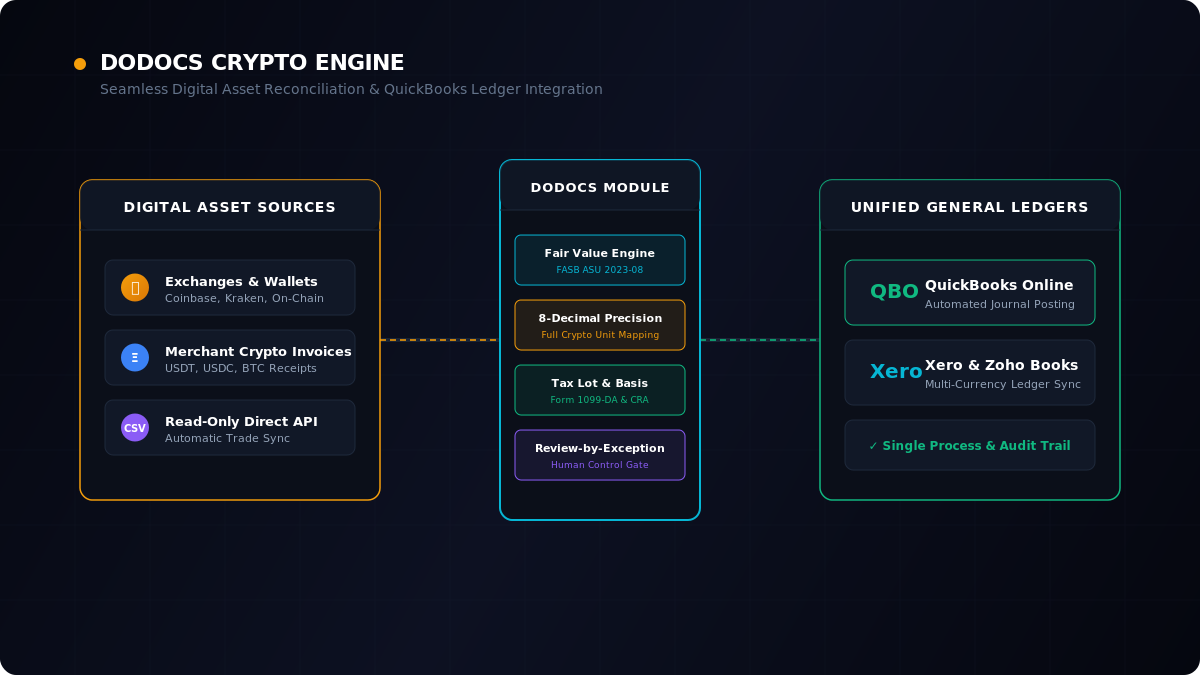
Crypto accounting that works inside QuickBooks: we are building it with accountants
By Dan Gudkov | November 16, 2026 | 5 min read
Automating Catch-Up Bookkeeping for CAS Practices
By DoDocs Editorial Team | November 16, 2026 | 7 min read