The Trillion-Dollar Shift
The SaaS industry is valued at over $1 trillion. But the model that built it — selling access to tools via per-seat subscriptions — is being disrupted by AI agents that deliver outcomes, not interfaces. The question isn't whether the shift will happen, but who will adapt first.
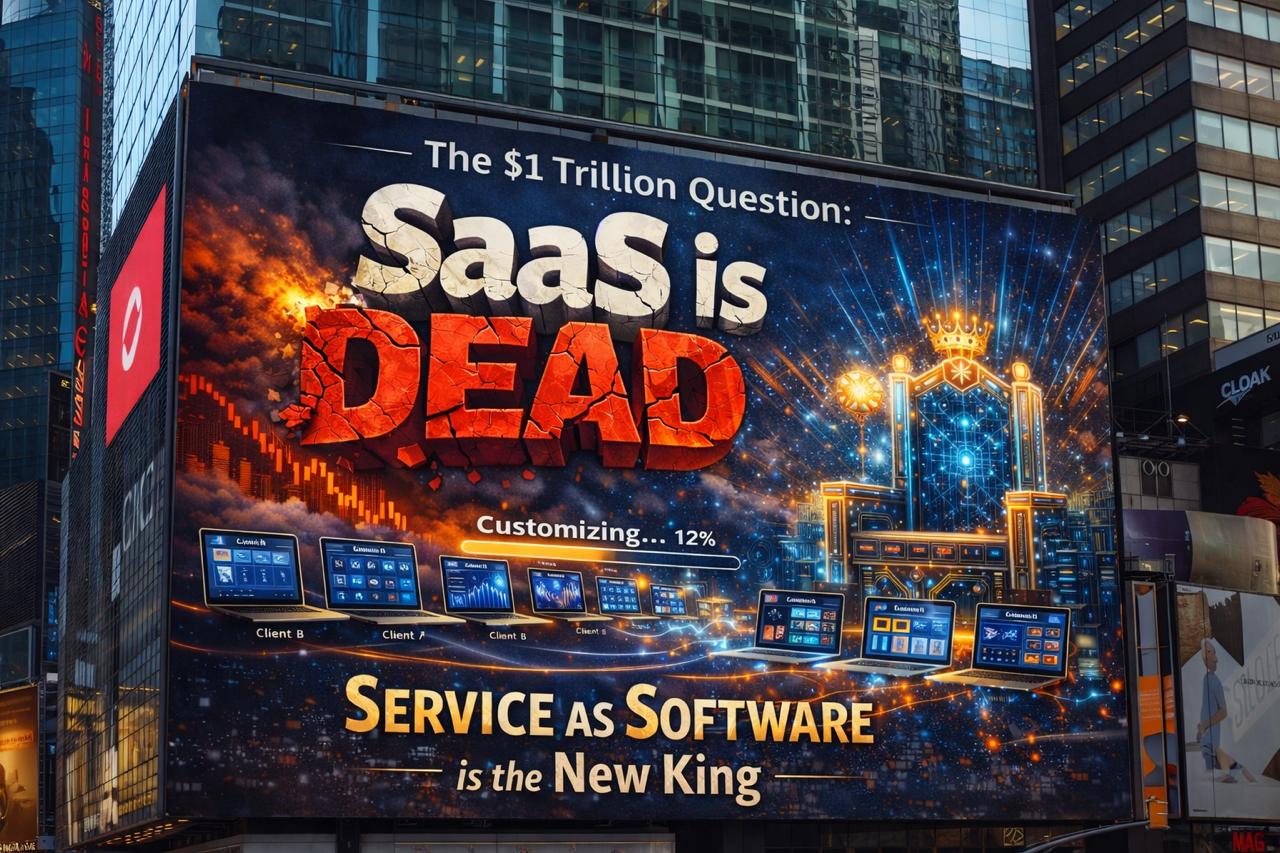
For two decades, SaaS has been the dominant model for enterprise software. The pitch was simple and powerful: instead of buying expensive on-premise licenses, rent access to cloud-hosted tools on a per-user, per-month basis. It worked. It created some of the most valuable companies in history. Salesforce, Workday, ServiceNow — the SaaS playbook minted a generation of tech giants.
But something fundamental has changed. The rise of AI agents — systems that don't just assist humans but actually execute work autonomously — is exposing a structural flaw in the SaaS model that was always there but never mattered until now.
SaaS sells tools. Customers want outcomes.
That gap between what SaaS delivers and what customers actually need is where the entire industry is about to break apart.
What Is Service-as-Software?
Service-as-Software inverts the SaaS model. Instead of providing a tool and leaving the human to do the work, Service-as-Software uses AI agents to execute entire workflows end-to-end. The software doesn't help you do the job — it does the job.
SaaS: The Tool Model
- Sells access to software interfaces
- Priced per seat, per month
- Value depends on human effort using the tool
- Revenue scales with headcount
- Customer pays whether they use it or not
- Success = adoption and engagement metrics
Service-as-Software: The Outcome Model
- Delivers completed work via AI agents
- Priced per outcome or per task
- Value is delivered by the software itself
- Revenue scales with work volume
- Customer pays for results delivered
- Success = outcomes achieved and work completed
Think about it this way: a SaaS accounting tool gives you a dashboard and expects you to reconcile invoices. A Service-as-Software system reconciles the invoices for you and tells you when it's done — or when it needs your attention on an exception.
Why SaaS Is Dying
The SaaS model isn't failing because it's bad. It's failing because something better is now possible. Three structural problems that were tolerable in the pre-AI era are now fatal.
The Seat-Based Pricing Trap
SaaS pricing is fundamentally misaligned with customer value. When you pay per seat, you're paying for the potential to get work done, not for work actually completed. This creates perverse incentives on both sides:
The Misalignment: SaaS vendors are incentivized to maximize seats (more users = more revenue), while customers are incentivized to minimize seats (fewer licenses = lower cost). Neither side is optimizing for actual outcomes.
When AI can do the work that previously required a human sitting in front of a SaaS tool, the per-seat model collapses. Why pay for 50 seats when an AI agent can do the work of 50 people? The value wasn't in the seats — it was in the work getting done.
The Integration Nightmare
The average enterprise runs over 200 SaaS applications. Each one was sold as a solution but became a silo. Data lives in fragmented systems that don't talk to each other. The result? Companies hire people whose entire job is to move data between SaaS tools — exporting CSVs, copy-pasting between tabs, reconciling discrepancies.
SaaS tools optimized for individual tasks but created a meta-problem: the work of connecting tools became as burdensome as the work the tools were supposed to eliminate. Service-as-Software doesn't have this problem because it owns the entire workflow, not just one step in it.
The AI Capability Gap
Most SaaS vendors are retrofitting AI onto products that were designed for human users. They're adding "AI assistants" and "copilots" to interfaces that were built for people to click through. This is like adding a motor to a horse-drawn carriage — it's an improvement, but it's not a car.
Service-as-Software is AI-native. The entire system is designed around AI agents executing work, with human oversight only where needed. There is no user interface to "use" in the traditional sense — the AI does the work and surfaces results, exceptions, and decisions that require human judgment.
The Economic Shift
The transition from SaaS to Service-as-Software isn't just a technology shift — it's an economic revolution that changes how software value is created, delivered, and captured.
The Three Eras of Enterprise Software Economics
Era 1: On-Premise
Pay for Ownership
Large upfront license fees. You own the software. You run the infrastructure. Value delivery depends entirely on your implementation capability.
Era 2: SaaS
Pay for Access
Monthly subscriptions. Vendor runs the infrastructure. But value delivery still depends on humans using the tool effectively. You rent the tool; you still do the work.
Era 3: Service-as-Software
Pay for Outcomes
Per-outcome pricing. AI agents execute the work. Value is delivered by the software itself. You pay for results, not potential.
For enterprise buyers, this shift is profound. Instead of purchasing tools and hoping your team uses them effectively, you purchase outcomes directly. The budget conversation changes from "How many seats do we need?" to "How many invoices do we need processed?" or "How many documents do we need reviewed?"
Who Is Leading the Transition
The shift from SaaS to Service-as-Software is already underway, driven by companies that recognized the fundamental mismatch between the tool model and what customers actually want.
Document Processing
Traditional SaaS: Upload documents, manually review extracted data, correct errors, export to your systems. Service-as-Software: AI agents process documents end-to-end — classifying, extracting, validating, and routing data to destination systems with human review only for exceptions. The shift is from "here's a tool to help you process documents" to "your documents are processed."
Customer Support
Traditional SaaS: Ticketing systems that help agents track and respond to issues. Service-as-Software: AI agents that resolve customer inquiries directly — answering questions, processing refunds, updating accounts — escalating to humans only when the situation requires empathy or complex judgment.
Finance and Accounting
Traditional SaaS: Dashboards and tools for accountants to reconcile, report, and audit. Service-as-Software: AI agents that perform reconciliation automatically, generate reports, flag anomalies, and prepare audit trails — with human oversight for strategic decisions and regulatory sign-offs.
What This Means for Enterprise Buyers
If you're evaluating enterprise software today, the SaaS-to-Service-as-Software shift changes the decision framework entirely. Here's what to consider:
Ask Different Questions
Stop asking "How many features does this tool have?" Start asking:
- What outcomes does this deliver? Not what it enables — what it actually completes.
- How much human effort is still required? If the answer is "a lot," you're buying a tool, not a service.
- How is it priced? Per-seat pricing means you're still in the SaaS model. Per-outcome pricing means the vendor has confidence in their AI's ability to deliver.
- What happens to exceptions? Every process has edge cases. The best systems handle them gracefully, not by throwing them back at the user.
Evaluate Total Cost of Outcomes
SaaS total cost includes license fees plus the human labor to actually use the tool. Service-as-Software total cost is the price per outcome. For many workflows, Service-as-Software is dramatically cheaper even if the per-unit price seems higher, because it eliminates the hidden cost of human effort that SaaS relies on.
Plan for the Transition
You don't have to rip and replace overnight. The smart approach is to identify workflows where the gap between "tool" and "outcome" is largest — where you're paying for SaaS seats but still relying heavily on human labor to get results. Those are the workflows where Service-as-Software delivers the most immediate value.
What This Means for Document Processing
Document processing is one of the clearest examples of the SaaS-to-Service-as-Software transition in action. For years, enterprises bought document management and OCR tools that required humans to review, correct, and route every document. The tool made the human faster, but the human was still doing the work.
At DoDocs, we built the platform around the Service-as-Software principle from the start. Our AI agents don't just extract data from documents — they process documents end-to-end:
- Classification: Documents are automatically identified and categorized without human intervention
- Extraction: Data is extracted with contextual understanding, not just pattern matching
- Validation: Extracted data is cross-referenced and validated against business rules automatically
- Routing: Processed data flows directly to destination systems — ERPs, accounting software, databases
- Exception Handling: Only genuine exceptions that require human judgment are surfaced for review
The result? Our customers don't pay for seats. They pay for documents processed. The value equation is transparent: X documents processed at Y accuracy for Z cost. No hidden labor costs. No shelfware. No training programs to teach people how to use yet another tool.
The DoDocs Difference: We don't sell you a document processing tool and hope you use it well. We process your documents and deliver results. That's the Service-as-Software promise — and it's why the SaaS model for document processing is already obsolete.
The SaaS Era Is Ending
The $1 trillion SaaS industry was built on a revolutionary idea: that software should be accessible, affordable, and constantly improving. That idea was right. But the implementation — selling access to tools and leaving the work to humans — was always a compromise, limited by the technology of the time.
AI has removed that limitation. Software can now do the work, not just provide the tools. The companies that recognize this shift and adapt their models accordingly will define the next era of enterprise technology. The ones that don't will join the long list of industries disrupted by a better model.
The question for every enterprise software buyer and builder is simple: Are you buying tools, or are you buying outcomes?
The answer to that question will determine who thrives in the post-SaaS world — and who gets left behind.
Experience the Future of Document Processing
See how DoDocs delivers outcomes, not just software. AI agents that process your documents end-to-end.